Long before Dracula, a Serbian farmer named Peter Plogojowitz refused to stay buried.
He died in 1725 in a village called Kisiljevo, and within days, nine of his neighbors were dead too. Each one swore on their deathbed that Plogojowitz had visited them in the night.
Villagers dug up his grave. They found his hair and nails had grown, his skin looked fresh, and blood filled his mouth.
That is vampire folklore history in its raw form, decades before any novelist got involved.
The myth started with dirt under fingernails and fear in small border villages, and it took two centuries to become the velvet and lace icon you recognize today.
The Real Vampire Panics That Started It All
The Plogojowitz case was not an isolated vampire folklore story.
It was the first of several documented vampire panics that swept the Balkans in the early 1700s, and each one triggered a formal government response.
The region had just changed hands between the Ottoman and Habsburg empires under the Treaty of Passarowitz in 1718, which meant Austrian officials were suddenly responsible for villages steeped in older Slavic beliefs about the restless dead.
That collision of bureaucracy and folk religion is exactly why these cases got written down at all.
Peter Plogojowitz, the Farmer Who Would Not Stay Dead
Austrian official Ernst Frombald filed the original report on Plogojowitz in 1725.
He was not a folklorist or a priest. He was a government administrator sent to keep order in newly annexed territory,
He ended up documenting something he could not explain.
Villagers exhumed the body, drove a stake through the chest, and burned the remains.
Frombald’s account ran in the Viennese newspaper Wienerisches Diarium that same year.
It spread across Europe within months, one of the first times the word vampire reached a mass audience in print.
Arnold Paole and the Visum et Repertum Report
Six years later, a similar panic broke out in the village of Medveđa.
A former soldier named Arnold Paole had died after falling from a hay wagon, and villagers blamed him for a string of sudden deaths that followed, at least sixteen by some counts.
This time, the Austrian military sent a full team. Regimental field surgeon Johannes Flückinger led the investigation and produced a report titled Visum et Repertum, Latin for seen and discovered.
The document described exhumed bodies in clinical detail and concluded, in the surgeons’ own professional opinion, that the villagers’ fears held up.
That official seal of credibility is what pushed the story past regional gossip and into European intellectual debate.
Even Voltaire wrote about the Medveđa case, arguing against it, but the fact that trained physicians had signed their names to a vampire report kept the argument alive for decades.
Where the Word “Vampire” Actually Comes From
The word “vampire” itself predates both cases by centuries.
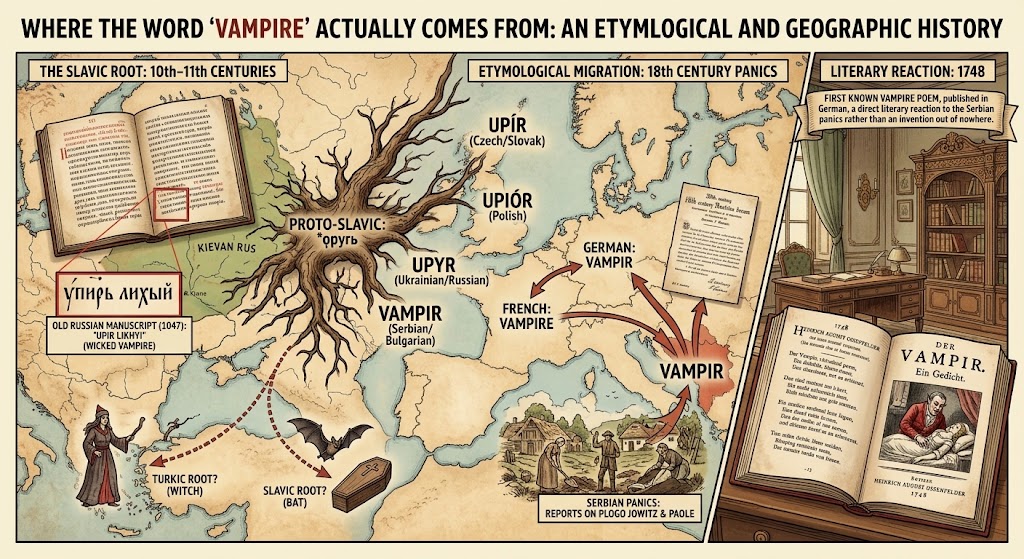
Linguists trace vampire back to the Slavic root upir, which shows up in an Old Russian manuscript from 1047 describing a prince nicknamed Wicked Vampire.
From there, the word moved through Serbian as vampir, into German as Vampir during the reports on Plogojowitz and Paole, then into French and English by the mid-1700s.
Every Slavic language kept its own version: upiór in Polish, upyr in Russian, vampir in Bulgarian.
Linguists still argue over the deepest root, with some pointing to a Turkic word for witch and others linking it to an old Slavic word for bat.
What is not up for debate is the geography. This word, and the belief system behind it, is Eastern European first and everything else second.
The first known vampire poem, Heinrich August Ossenfelder’s Der Vampir, was published in German in 1748, a direct literary reaction to the Serbian panics rather than an invention out of nowhere.
What Made Someone a Vampire in Folk Belief
Folklore across the Balkans and Slavic Europe had specific rules about who came back from the grave, and it rarely had anything to do with romance or seduction.
Signs of a Vampire in the Grave
A death considered unclean or unnatural put a person at risk.
That included suicide, murder, dying without last rites, or dying while excommunicated.
When villagers exhumed a suspected vampire, they checked for the same details every time: a bloated body, dark or ruddy skin, blood around the mouth, and hair or nails that looked like they had kept growing.
Modern forensic science explains every one of those signs as ordinary decomposition, gas buildup, skin slippage, and fluid purging.
At the time, without that science, it looked like proof of something monstrous.
How Villagers Fought Back
Staking the corpse was the most common response, usually through the chest, sometimes pinning the body to the coffin floor so it could not rise.
Decapitation followed in many regions, with the head buried separately or wedged between the legs. Some villages packed the mouth with garlic or a brick.
Others scattered poppy seeds or millet around the grave, based on a folk belief that a vampire had to stop and count every seed before it could move, buying the living time until sunrise.
None of this matched the vampire-hunting kits sold as novelty items today.
It was closer to community disease control than horror movie ritual, carried out by frightened neighbors, not professional monster hunters.
From Serbian Graveyards to Gothic Fiction
The folklore vampire stayed a rural, unglamorous threat for nearly a century after Paole.
Its transformation into the character goths actually recognize happened in one specific place, a rented villa on Lake Geneva, during one specific, miserable summer.
In June 1816, Lord Byron, Mary Shelley, Percy Shelley, Claire Clairmont, and Byron’s personal physician John Polidori found themselves stuck indoors at the Villa Diodati through weeks of freak storms.
Byron proposed a contest: everyone would write a ghost story. Mary Shelley’s contribution became Frankenstein. Polidori’s became The Vampyre, published in 1819, and it changed the vampire for good.
Polidori had read the Paole reports and folded that Balkan folklore into a new character, Lord Ruthven, an aristocratic and magnetic predator who moved through London ballrooms instead of village graveyards.
Readers assumed Byron had written it, since Ruthven was a thinly veiled portrait of him, and the mix-up only made the story more famous.
That single shift, from decomposing farmer to seductive nobleman, is the hinge point of vampire folklore history. Everything that followed built on it.
Sheridan Le Fanu’s Carmilla arrived in 1872 with a female vampire and unmistakable queer subtext.
Bram Stoker’s Dracula followed in 1897, borrowing Transylvania’s geography and folding in older Eastern European superstition, and it cemented the vampire as an aristocrat with old-world manners and a taste for young Victorian blood.
By the time Stoker was done, the farmer from Kisiljevo had all but disappeared from the myth.
The Vampire Folklore History Aesthetic Still Shapes Gothic Style Today
Here is the direct line from a Serbian farmer’s grave to your closet.
The vampire aesthetic goths wear now- deep velvet, structured corsetry, pale foundation, blood-red accents- comes almost entirely from that nineteenth-century literary reinvention, not the original folklore. Polidori and Stoker gave the vampire wealth, elegance, and a wardrobe.
Readers who wanted the vampire folklore history fantasy to feel real translated it into fashion, and the look never really left.
If you are building that aesthetic, a few pieces make the connection obvious.
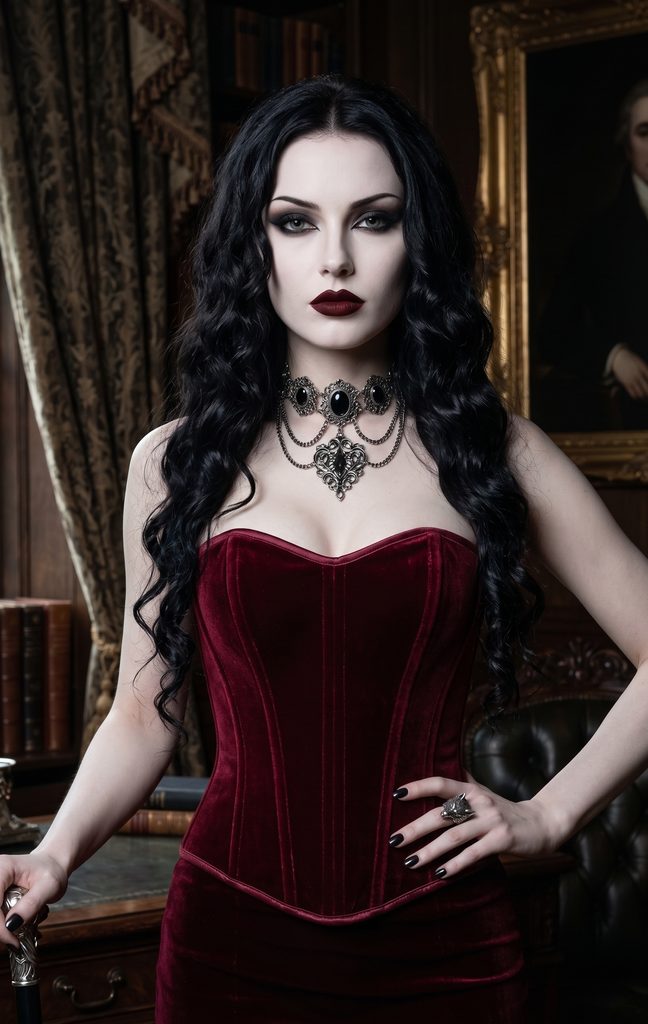
A structured velvet corset top nods straight to the Lord Ruthven era of aristocratic menace, especially in black or a deep wine red.
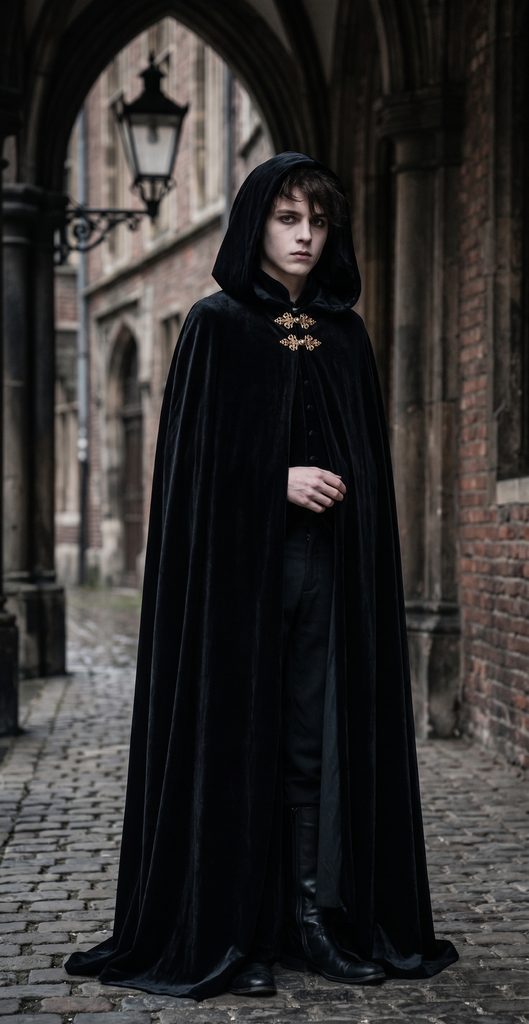
A floor-length hooded velvet cloak channels that same nobleman-in-the-shadows silhouette without tipping into costume territory.

For everyday wear, a matte black lipstick in a blood red shade does more to sell the vampire mood than any fang set from a Halloween pop-up shop.
None of this vampire folklore history is really accurate. The real folklore vampire was a bloated corpse in a work shirt, not a count in a cape.
But fashion borrowed the fiction, not the farmer, and that borrowed version is the one we are all actually dressing as every October.
If you want to go deeper into how the fiction developed after Polidori, Anne Rice’s Vampire Chronicles took the aristocratic vampire and gave it a modern, romantic interior life, and it rewards a read once Polidori and Stoker have you hooked.
For outfit ideas that build on this exact silhouette, GothicMood’s guides to Victorian goth dresses and Gothic corset tops both work straight from the aristocratic vampire template this history created.
FAQ
Did people really believe vampires were real?
Yes. Vampire panics in the Balkans triggered real government investigations, including military-led exhumations documented in official reports. Educated Europeans debated the topic seriously throughout the 1700s, and physicians put their professional names behind vampire findings.
What is the oldest documented vampire case?
The Peter Plogojowitz case from 1725 in Kisiljevo, Serbia, is the earliest well-documented vampire panic, recorded by an Austrian official and reported across Europe within the year.
Why did villagers dig up graves looking for vampires?
Sudden, unexplained deaths in a village triggered suspicion that a recently deceased person had become a vampire. Exhuming the body let villagers check for supposed warning signs, like a preserved corpse or blood at the mouth, both of which are actually normal parts of decomposition.
Is Dracula based on a real vampire?
Not directly. Bram Stoker built Dracula from a mix of Eastern European folklore, the aristocratic vampire template Polidori created in 1819, and loose historical flavor from the region, rather than any single documented case.
What is the difference between folklore vampires and the gothic fiction version?
Folklore vampires were reanimated corpses tied to specific villages and blamed for local deaths. Gothic fiction, starting with Polidori’s The Vampyre in 1819, recast the vampire as a wealthy, seductive outsider, and that version is what shaped modern gothic fashion and pop culture.
Affiliate disclosure: This post contains affiliate links. GothicMood earns a commission on qualifying purchases at no extra cost to you.