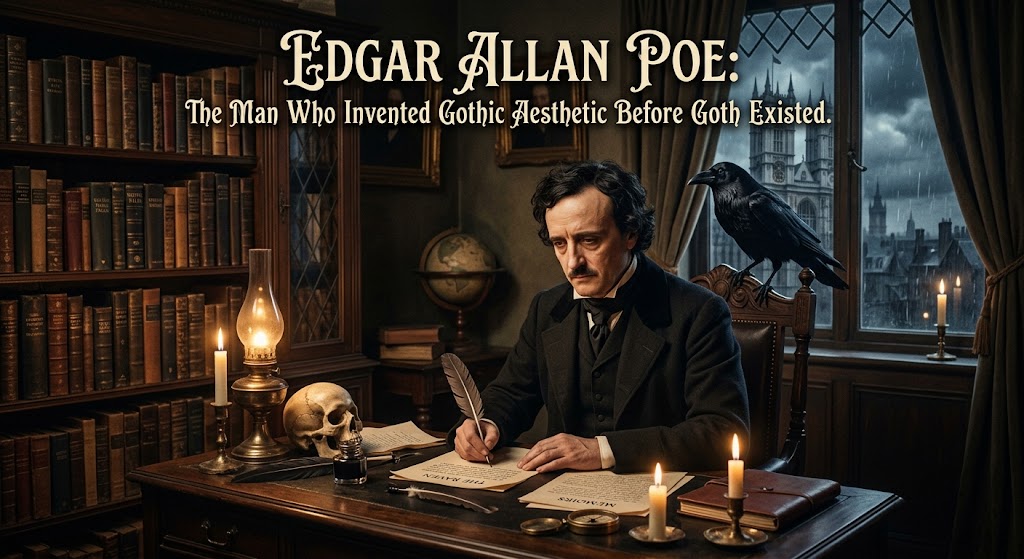
Edgar Allan Poe died broke and delirious in a Baltimore hospital in October 1849.
He was wearing clothes that weren’t his, calling out a name nobody could ever explain, four days after a stranger found him slumped outside a public house that doubled as a polling station.
He never got the marriage he was hoping for. He never got the money. He barely got credit for the poem that made him famous while he was still alive to starve.
He did get uncannily good at building dread, good enough that goths still treat him like a patron saint more than 130 years before the word “goth” meant anything. Crumbling houses. Beautiful, doomed women.
Narrators who confess their crimes because guilt is louder than fear. That specific flavor of dread you recognize on sight? Poe built it, tale by tale, out of his own miserable life.
Here’s how one broke magazine editor from Baltimore became the father of gothic aesthetic, and why his fingerprints are still all over goth culture today.
A Childhood Built for Gothic Fiction
Poe was born in Boston on January 19, 1809, the second child of two touring actors. His father drank, gambled, and vanished before Poe turned two.
His mother, Eliza, kept working the stage until tuberculosis caught up with her at the end of 1811. She died before Poe’s third birthday, and the family scattered within the year.
His older brother went to relatives in Baltimore. His baby sister went to one family friend. Poe went to another: John Allan, a wealthy Richmond merchant, and his wife Frances, who doted on the boy but never made the guardianship legal.
That’s where the “Allan” in Edgar Allan Poe comes from, a middle name borrowed from a man who spent the rest of his life resenting what it cost to raise him.
The Allans spent five years in Britain when Poe was a child, and he attended boarding schools in Scotland and England, including one in Stoke Newington that later became the setting for his short story “William Wilson.” Back in Richmond, Poe enrolled at the University of Virginia in 1826.
He drank, gambled to cover a tuition shortfall Allan refused to close, and dropped out within a year, buried in debt.
He enlisted in the army under a false name and a lie about his age, made it as far as West Point, then got himself deliberately court-martialed in 1831 once Allan cut him off for good. By 22, Poe had already lived enough chaos for three gothic novels. He just hadn’t started writing them yet.
The Gothic Tradition Poe Pushed Against
Poe didn’t invent gothic literature. The genre had a 60-year head start by the time he published his first short stories in the early 1830s.
From Horace Walpole’s haunted castles all the way to a ghost-story challenge Lord Byron issued to his houseguests at Villa Diodati in the summer of 1816- the same rain-soaked summer that produced Mary Shelley’s Frankenstein and John Polidori’s The Vampyre.
Poe was seven years old when that happened, growing up an ocean away with no idea that two of gothic fiction’s foundational texts were being born in a borrowed villa on Lake Geneva.
What Poe inherited from that tradition, he immediately started arguing with. In the preface to his 1840 collection Tales of the Grotesque and Arabesque.
He pushed back on critics who accused him of copying the melodramatic “German” gothic romances popular at the time.
His defense became a kind of manifesto: terror, he wrote, “is not of Germany, but of the soul.” He wasn’t interested in haunted castles for their own sake.
He wanted the horror to come from inside a person’s head, and that shift is exactly what separates Poe’s gothic style from everything that came before it.
The Aesthetic Poe Actually Built
Strip the plots out of Poe’s best stories, and you’re left with a mood board that goth culture still runs on.
Decaying architecture that mirrors a decaying mind, like the literal crack splitting the House of Usher in two.
Rooms lit only by candles, packed with velvet and old books, where a character can retreat completely from daylight.
Obsession dressed up as love, and love that curdles into death before the story ends.
In his essay “The Philosophy of Composition,” Poe argued flatly that the death of a beautiful woman was the most poetic subject in the world, which is either the most romantic or the most unsettling sentence a 19th-century writer ever put on paper, depending on your mood.
None of it was accidental. Poe wrote criticism as sharp as his fiction, and he treated atmosphere like a science: pick one emotional effect, then build every sentence toward it.
That discipline is what turned scattered haunted-house tropes into a full aesthetic system, one goths could pick up a whole century later and recognize instantly as their own.
It’s a genuine milestone in gothic literature history, even if Poe never lived to see anyone call it that.
Poe’s Aesthetics

The Genre You Don’t Usually Associate With Poe
Poe’s other legacy rarely makes it onto goth mood boards, but it’s just as large. In 1841, he published “The Murders in the Rue Morgue” and introduced C. Auguste Dupin, an amateur genius who solves crimes through pure logic while a slower-witted narrator writes the whole thing down.
Sound familiar? Arthur Conan Doyle borrowed that exact template decades later to build Sherlock Holmes and Dr. Watson. Poe basically invented the detective story while also writing some of the most influential horror fiction of his century, on a ten-dollar-a-week magazine salary, with a dying wife at home.
From Poverty to Patron Saint
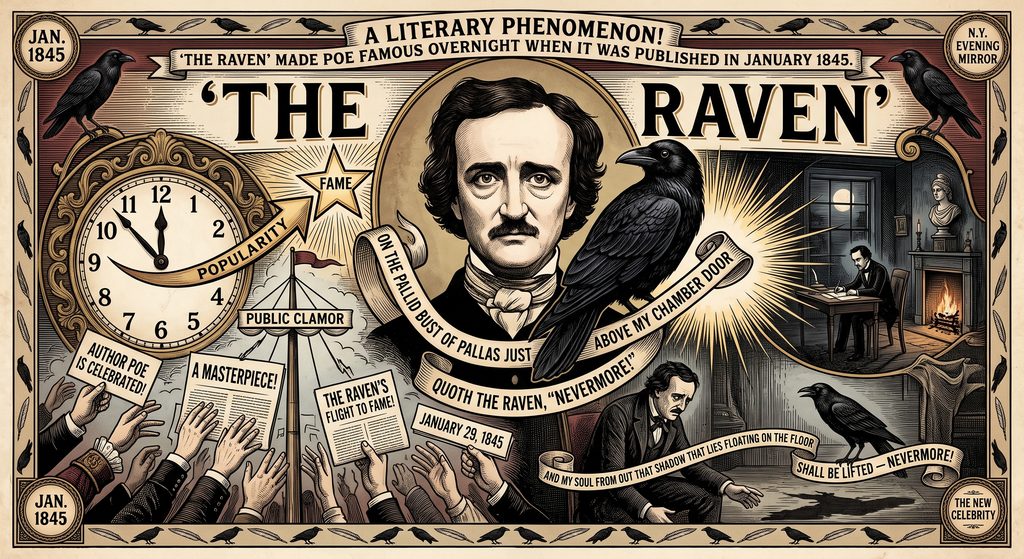
“The Raven” made Poe famous overnight when it was published in January 1845. He was paid nine dollars for it. His wife Virginia, who was also his cousin, died of tuberculosis two years later at 25, and Poe followed her in October 1849, found in distress outside a Baltimore tavern in someone else’s clothes.
His medical records are lost. Historians still argue over whether alcohol, a brain lesion, or a form of election fraud called cooping killed him.
Nobody knows for certain, and that loose end turned out to be very on-brand for a man who spent his career building mysteries with no tidy resolution.
His reputation got worse before it got better. A rival editor named Rufus Griswold became Poe’s literary executor after his death and used the position to publish a smear campaign dressed up as a memoir, inventing anecdotes and rewriting Poe’s own letters to paint him as a depraved, drug-addled madman.
It should have buried him for good. Instead, it built the myth. French poet Charles Baudelaire translated Poe’s stories and turned him into a touchstone for a whole generation of Symbolist writers.
American horror writers from H.P. Lovecraft to Stephen King have named him as a direct influence.
And when goth culture emerged out of post-punk clubs in the late 1970s, more than a century after Poe’s death, it inherited an aesthetic vocabulary he had already spent a career perfecting: black clothing, candlelight, obsession, decay, and death treated as something closer to beauty than tragedy.
That’s the throughline connecting Poe to modern goth identity, and to the wider gothic literature history that also runs through Mary Shelley’s Frankenstein and the vampire folklore that eventually produced Dracula.
If Poe’s obsessive narrators and doomed romances hook you, modern dark romance books push that same obsession into present-day territory, and Anne Rice’s Vampire Chronicles pick up his morbid romanticism and give it fangs, literally.
Frequently Asked Questions
What genre did Edgar Allan Poe write in?
Poe wrote gothic horror, poetry, and literary criticism, and he’s also credited with inventing detective fiction through his character C. Auguste Dupin. His short stories, including “The Fall of the House of Usher” and “The Tell-Tale Heart,” remain the clearest blueprint for American gothic horror writing.
Was Edgar Allan Poe part of the goth subculture?
No. Poe died in 1849, more than a century before goth emerged as a subculture out of post-punk music scenes in the late 1970s. Goths adopted him afterward as a literary ancestor, not a contemporary.
How did Edgar Allan Poe die?
Historians still dispute it. Contemporary reports blamed “congestion of the brain,” a term often used for alcohol-related death, but modern biographers have also pointed to a brain lesion, heart failure, or a 19th century voting scam called cooping. His medical records were lost, so no theory has ever been confirmed.
What did Edgar Allan Poe invent?
Poe is credited with writing the first modern detective story, “The Murders in the Rue Morgue,” and with developing the psychological horror short story into its modern form. His work on rhythm and structure, especially in “The Raven” and his essay “The Philosophy of Composition,” also shaped how later poets approached form.
Is Edgar Allan Poe connected to Frankenstein or Dracula?
Not directly, but they share a family tree. The 1816 ghost-story contest at Villa Diodati that produced Mary Shelley’s Frankenstein and John Polidori’s The Vampyre happened while Poe was a child, and it helped shape the wider gothic tradition Poe would later write against and build on.
GothicMood participates in affiliate programs, including Amazon Associates. If you buy something through a link on this page, we may earn a small commission at no extra cost to you.